1-800-260-8830

Automotive Electronics Component Sourcing
in a Rapidly Changing Market

Building a More Resilient Supply Chain for EVs, Connected Vehicles,
and Next-Generation Automotive Technology

Click Image To Enlarge

Automotive manufacturing has been transformed by electronics. As vehicles become increasingly connected, electrified, automated, and software-driven, a greater dependency on sophisticated electronic components is being created throughout the automotive supply chain.

At the same time, procurement teams are being challenged by fluctuating component availability, changing lead times, product lifecycle issues, pricing pressure, and increasingly complex qualification requirements. Therefore, greater attention is being placed on the sourcing strategies and supplier relationships that can help manufacturers remain flexible when market conditions change.


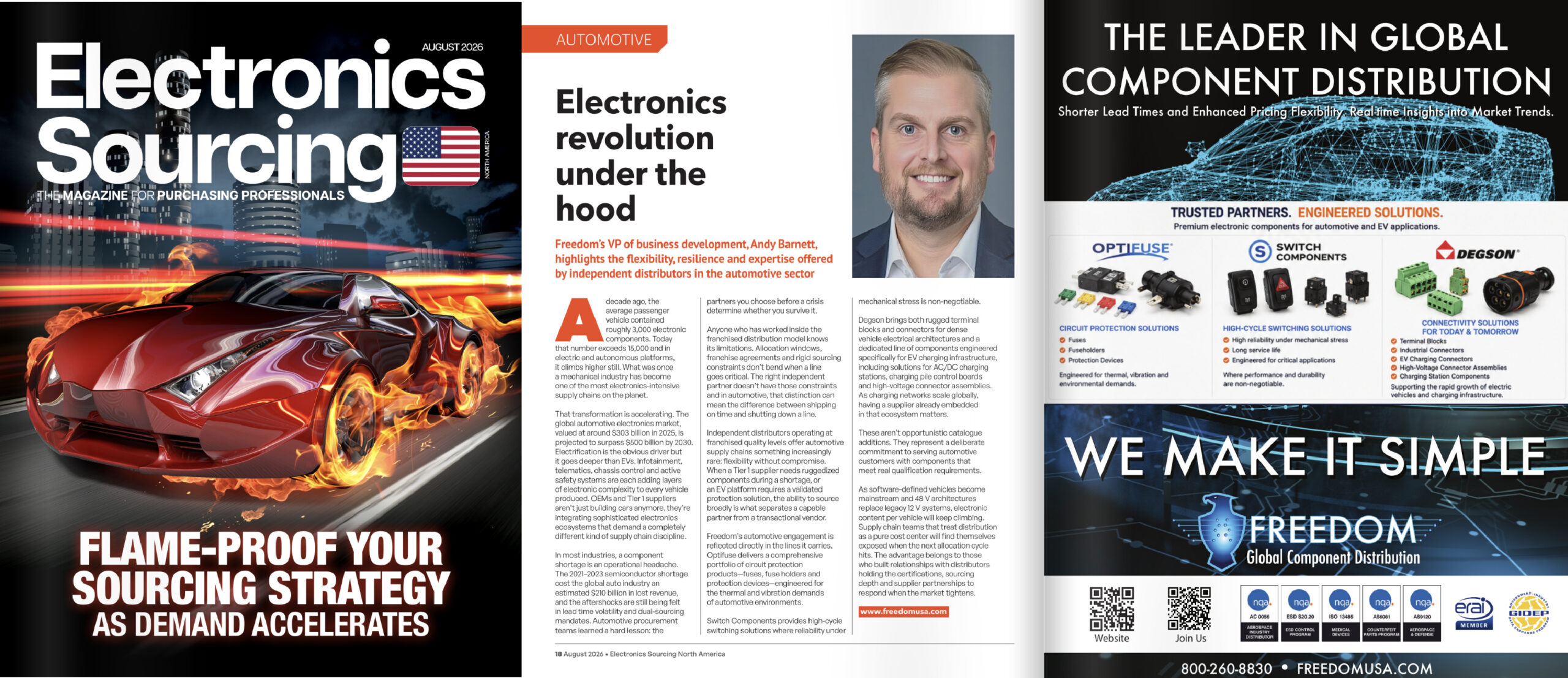
These challenges were recently addressed by Andy Barnett, VP of Business Development at Freedom USA, in the August 2026 edition of Electronics Sourcing North America. His article, Electronics Revolution Under the Hood,”examines the growing importance of independent distribution as automotive electronics continue to evolve.

The issue is bigger than simply finding parts. The right sourcing strategy can help automotive manufacturers and suppliers improve visibility, respond to disruption, manage component lifecycles, and keep production moving.

The Electronics Revolution Under the Hood

A modern automobile is no longer primarily a mechanical product with electronics added to it. Electronics have become fundamental to how vehicles operate, communicate, manage power, protect passengers, and interact with the world around them.

Advanced driver assistance systems, infotainment, connectivity, battery management, power electronics, sensors, charging systems, lighting, and vehicle control systems have all contributed to greater electronic content.

Electric vehicles accelerate this transformation even further.

As automotive technology advances, manufacturers must manage a much larger and increasingly sophisticated electronic component ecosystem. That means the performance of the automotive supply chain is becoming directly connected to the performance of the vehicle itself.

Why Automotive Component Sourcing Has Become More Complex

Automotive procurement has always required careful planning. However, the increasing amount of electronics within vehicles introduces additional sourcing challenges.

A single component shortage can affect an entire production schedule.

This became especially clear during the semiconductor shortages of recent years, when automotive manufacturers around the world experienced production interruptions because relatively small electronic components were unavailable.

Today, procurement teams must prepare for more than shortages alone.

They must consider:

  • Component availability
  • Extended or changing lead times
  • Price volatility
  • Product lifecycle changes
  • Obsolescence and end-of-life notices
  • Supplier capacity
  • Component authenticity
  • Quality requirements
  • Geographic supply chain disruptions
  • Rapid changes in vehicle technology

The result is a sourcing environment where flexibility and visibility have become increasingly valuable.

EV Growth Is Changing Electronic Component Demand

Electric vehicles require a different electronic architecture than traditional internal combustion vehicles.

Battery management systems, power conversion, charging infrastructure, thermal management, high-voltage systems, connectivity, and electronic control systems all depend on specialized components.

As EV platforms continue to evolve, manufacturers and suppliers may need to source components across multiple categories while simultaneously preparing for changing designs and product generations.

This can create situations where one component is entering high demand while another is approaching the end of its lifecycle.

For procurement teams, the challenge becomes balancing today’s production requirements with tomorrow’s technology roadmap.

Software-Defined Vehicles Add Another Layer of Complexity

The transition toward software-defined vehicles is also changing the relationship between automotive hardware and electronic components.

Vehicle functions that were once controlled primarily through dedicated mechanical or electronic systems are increasingly being managed through centralized computing architectures, advanced processors, sensors, connectivity, and software.

As these architectures evolve, the components supporting them must evolve as well.

That can shorten useful component lifecycles and create additional pressure on sourcing teams to anticipate redesigns, substitutions, and future availability.

A sourcing decision is therefore no longer based solely on whether a component can be purchased today. Its expected availability throughout the life of the program should also be considered.

Component Obsolescence Cannot Be an Afterthought

Automotive platforms can remain in production and service for many years. Electronic component lifecycles can move much faster.

That mismatch creates one of the industry’s most important sourcing challenges.

A semiconductor, connector, memory device, switch, or other electronic component may be changed or discontinued while the automotive system using it is still expected to remain in production.

When obsolescence is discovered too late, manufacturers may face:

  • Costly redesigns
  • Last-time-buy decisions
  • Unexpected inventory requirements
  • Production delays
  • Emergency sourcing
  • Component requalification
  • Increased procurement costs

A proactive lifecycle strategy can help identify these risks earlier and provide more time to develop alternatives.

Why Supplier Relationships Matter Before a Shortage Occurs
and The Benefits of Choosing Freedom USA
for Automotive Component Sourcing

One of the most important lessons from recent electronics supply chain disruptions is that supplier relationships should be established before components become difficult to find.


During periods of normal availability, procurement teams have more flexibility. During a shortage, that flexibility can disappear quickly.


This is where an experienced independent distributor can provide additional sourcing options.


Freedom USA combines global sourcing capabilities, market intelligence, supplier relationships, inventory resources, and industry experience to help customers respond when traditional supply channels become constrained.


Rather than being viewed only as an emergency source, an independent distributor can become part of a broader sourcing strategy designed to provide flexibility before a disruption occurs.


Quality and Traceability Remain Critical

Availability alone is never enough in automotive electronics.

Electronic components must meet the quality, performance, authenticity, and traceability expectations associated with the application.


For this reason, sourcing through an independent distributor should involve much more than locating inventory.


Supplier qualification, inspection processes, component handling, documentation, quality management, and traceability should all be considered when evaluating a sourcing partner.


Freedom USA’s broader quality and sourcing infrastructure has been developed to help customers gain access to components while maintaining the standards required for demanding applications.


Automotive Connectivity Requires Rugged Component Solutions

As vehicles become increasingly connected and electrified, the physical components connecting automotive systems must also withstand demanding operating environments.


Switches, connectors, terminal blocks, circuit protection products, and other electromechanical components may be exposed to heat, vibration, moisture, electrical loads, and continuous mechanical stress.


Freedom USA’s growing portfolio provides access to solutions supporting these applications, including products from OptiFuse, Switch Components, and Degson.


These technologies can support applications ranging from circuit protection and high-cycle switching to terminal blocks, industrial connectors, EV charging connectors, and other connectivity requirements.


The objective remains simple: match the right component and sourcing strategy to the demands of the application.


Automotive electronics require more than access to inventory. They require a sourcing partner capable of responding to changing market conditions while supporting quality, availability, and long-term supply chain objectives.


By working with Freedom USA, customers can benefit from:


As automotive electronics continue to evolve, the ability to adapt will become increasingly important. Freedom USA helps customers build that flexibility into their supply chain so they can respond to today’s requirements while preparing for what comes next.
Frequently Asked Questions About
Automotive Electronics Component Sourcing

What is automotive electronics component sourcing?

Automotive electronics component sourcing is the process of identifying, qualifying, purchasing, and managing electronic components used throughout vehicle systems. These components can include semiconductors, connectors, switches, circuit protection products, memory, sensors, microcontrollers, and other electronic and electromechanical devices.

Why is electronic component sourcing becoming more important in automotive manufacturing?

Modern vehicles contain increasingly sophisticated electronic systems. EVs, advanced driver assistance systems, connectivity, infotainment, battery management, and software-defined vehicle architectures have increased the industry’s dependence on electronic components.

How can an independent electronic component distributor support automotive manufacturers?

An independent distributor can provide additional sourcing options when components are allocated, obsolete, difficult to locate, experiencing extended lead times, or unavailable through traditional channels. Independent distributors can also provide market intelligence and lifecycle support.

What causes electronic component shortages in the automotive industry?

Shortages can be caused by increased demand, limited semiconductor manufacturing capacity, supply chain disruptions, geopolitical events, raw material constraints, transportation issues, unexpected demand from other industries, and changes in component production.

How does component obsolescence affect automotive manufacturers?

Automotive products often remain in production longer than the electronic components used within them. When a component reaches end-of-life, manufacturers may need to locate remaining inventory, qualify an alternative, redesign a system, or establish a last-time-buy strategy.

Why is component quality important when sourcing automotive electronics?

Automotive electronics operate in demanding environments and can support critical vehicle functions. Component authenticity, quality, proper handling, inspection, documentation, and traceability should therefore be considered when selecting a sourcing partner.

Does Freedom USA source obsolete and hard-to-find automotive components?

Freedom USA provides sourcing solutions for allocated, obsolete, end-of-life, and difficult-to-find electronic components through its global supplier network and component sourcing capabilities.

How can automotive manufacturers prepare for future component shortages?

Manufacturers can improve resilience by monitoring component lifecycles, identifying critical parts, developing alternative sourcing relationships, monitoring market conditions, evaluating potential substitutions, and establishing sourcing strategies before shortages occur.

Contact Freedom today
1-800-260-8830

to experience why so many businesses continue to rely on a partner that places your success at the center of everything.

Connect with Freedom  and secure the components and service your business demands.

Join Our mailing List

Benefit from Industry Trends & Insights

Our Clients Are Our Top Priority

Freedom USA
© 2024 All Rights Reserved • Freedom USA • 08/21/2026